Ugarit-Verlag — Buch- und Medienhandel GmbH
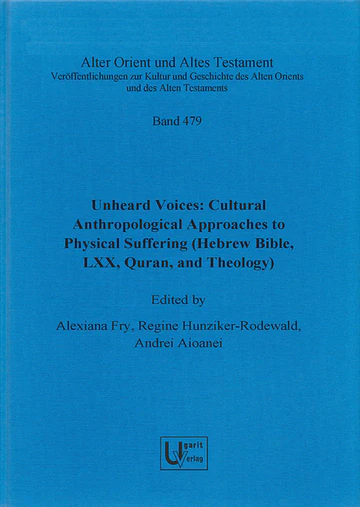
Unheard Voices
Unheard Voices
Herausgeber
Alexiana Fry, Regine Hunziker-Rodewald, Andrei Aioanei
Inhaltsverzeichnis
Table of Contents
List of Contributors
Acknowledgments (Regine Hunziker-Rodewald, Alexiana Fry, Andrei Aioanei)
Foreword – People of the Speech and People of Silence (Guillaume de Vaulx d’Arcy)
Introduction – Toward an Anthropology of the Unheard (Regine Hunziker-Rodewald, Alexiana Fry, Andrei Aioanei)
Part I – Unheard Bodies: Pain and Emotional Expression
I.1 Sons and Daughters, Wife, Servants, and Animals: Job’s Unheard Voices of Suffering and their Theological Echo (Stéphanie Anthonioz)
I.2 The Ellipsis: A Tool to Mind the Gaps of Pain in Numbers 31 (Alexiana Fry)
I.3 Thrashing Someone in Succoth (Judges 8) (Tammi J. Schneider)
I.4 Joseph’s Weeping: Trauma, Ambiguous Grief, and Ritually Revisiting the Past to Reclaim the Future (Katherine E. Southwood)
I.5 Regain Silenced Voices: Expressions of Pain in the Light of Blended Voices in Jeremiah 4, 8-9, and 14 (Martina Weingärtner)
Part II – Unheard Under Power: Gender, Violence, and Authority
II.1 ‘But He Would Not Listen to Her Voice’: A Critical Analysis of the Rape of Tamar (2 Sam. 13:1–22) from the Perspective of the Victim (Gaël Carriou)
II.2 Unheard Cries for Justice: An Intertextual Study of Zāʿāq and Ṣāʿāq (Leah Cech)
II.3 Physical and Emotional Pain in Judges 19.25-26 (Daniela Gelbrich) 5
Unheard Voices, hg. Fry, Hunziker-Rodewald & Aioanei
Part III – Unheard Before the Divine: When Managed Hearing Becomes Theology
III.1 Ὁ κλῆρος τοῦ ἀποπομπαίου in LXX Leviticus 16:7-10 (Evangelia G. Dafni)
III.2 Job’s Most Intimate Circle (Wife and Children): Mediator of the Sense of His Patience in Suffering According to the Qur’anic Narrative (Geneviève Gobillot)
III.3 Without a “Soundtrack”: Syntax, War Violence, and the Unheard in Judges 11:19-24 (Regine Hunziker-Rodewald and Andrei Aioanei)
III.4 Disfigured Face, Unheard Voice: Reflections on the Divine Encounter in Daniel 10:8 from an Eastern Christian Perspective (Cătălin Vatamanu) Evaluation – At the Edge of Utterance: A Response to Unheard Voices (Danilo Verde)
Index (NN) to be done later
Beschreibung
When it comes to non-focal figures, the Hebrew Bible and Ancient Near Eastern texts often steer attention away from hard anthropological questions – especially physical pain and its emotional expression. Although recent work has probed the lexicon of pain with theological, linguistic, and historical-anthropological methods (e.g., Bauks & Olyan 2021), the embodied experience of non-protagonists remains misrepresented. Ancient authors and modern interpreters alike seldom attribute agency to wounded warriors, mutilated foes, expelled groups, or – indeed – women, children, men, and animals whose bodies are marked by illness, accident, disaster, or ritualized violence.
This volume seeks to restore the multivocality of physical suffering as preserved in the Hebrew Bible, the Qurʾān, and Ancient Near Eastern sources – for example, the imagined sighs, groans, and cries at the plot’s margins. By engaging varied anthropological methods and drawing on diverse corpora, we aim to contribute to an integrative, critical reading of scriptural texts and to surface a fuller range of voices (Pedersen & Cliggett 2021), reducing bias, blind spots, and ideological narrowness.
Keywords: cultural anthropology, emotion studies, embodied experience, multivocality, balance of power.
Bibliographische Angaben
Reihe + Nummer: AOAT 479
ISBN: 978-3-86835-379-2
Erscheinungsjahr: 2026
Seitenanzahl: vi + 286 pp.
无法加载取货服务可用情况
Teilen